![[personal profile]](https://www.dreamwidth.org/img/silk/identity/user.png) jazzy_dave
jazzy_daveJoseph Conrad "The Secret Agent" (Penguin Classics)
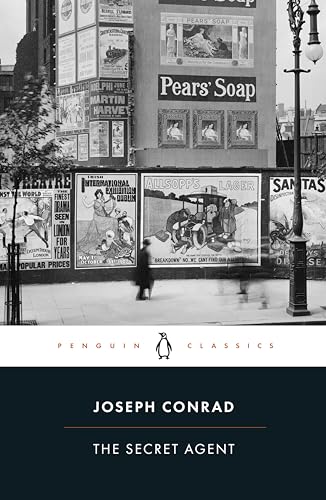
Joseph Conrad's 1907 novel not only predicts the rise of terrorism as a global force (and analyzes its anarchistic roots with probing curiosity and pungent wit), it also more or less created the genre of the spy novel, both the high artsy type John le Carre produces and the popular sort dished out by Tom Clancy. It's an important book, at times quite a good read. At times...
As when we meet the Professor, a sinister bomb-maker who fondles in his pants pocket the rubber-bulb detonator of the explosive he has strapped to his body as he walks the crowded streets of the city, to warn off any bobby who might try and mess with him. "They depend on life...a complex, organized fact open to attack at every point, whereas I depend on death, which knows no restraint and cannot be attacked," he sneers. "My superiority is evident."
Or the mentally retarded Stevie, the man-child so sensitive to the pain of others, even a starving horse that drives his mother's cab. He wishes only for comfort and joy for all, like the kind he knows when his loving sister tucks him into bed. "To be taken into a bed of compassion was the supreme remedy, with the only one disadvantage of being difficult of application on a large scale."
There are some humor and much wisdom in Conrad's novel. Conrad was a great writer, capable of capturing in often-meandering sentences some very difficult concepts about the world we live in and the complex psychology of those around us. At his best, he's brilliant. But "The Secret Agent" is more than a little windy, with a rambling narrative that introduces a bevy of characters but doesn't do very much with them and one key moment of action that happens outside the unnecessarily shifting narrative.
Some reviewers here have made mention of the fact those of us who don't appreciate Conrad here are guilty of being members of the MTV generation and so on. Yes, it's true, I have seen a music video, a Duran Duran one. I remember someone flipping a table... But the problem here isn't with modern readers' short-attention spans.
When Conrad was being discursive in "Lord Jim," which I read about five years ago, it was for the sake of delving into the many layers of a conflicted central character, filling a broad canvas with the stuff of a vast world at sea which threatened to drown Jim's overarching sense of self-importance if he didn't keep escaping into something else. There was a point to its narrative time shifts and here-and-gone secondary characters. In "The Secret Agent," one gets a sense of a slight yarn, no more than a short story really, being tricked up and slathered with unnecessary detail. The central character is a dull slug and a poser, his wife, the only mildly sympathetic character, is a little better, a Stepford Wife without the nice house.
Conrad's book starts off well, but then takes a sharp left turn after the central act of terror, petering out in a series of elliptical conversations, of little or no importance to the final resolution, where Conrad commentates on every unspoken thought and nuance of expression. The narrative becomes very slow and dull, to the point when we finally are given an act of on-screen violence, it's so lethargically rendered that the victim barely cries out before expiring. Some point about pointlessness is being made, for the 456th time.
That Conrad created here a genre that has served us well is beyond question. But it's only an okay book, not the best by Conrad or the best spy fiction by a long chalk. It's not even the best story about an unprincipled man named Verloc who causes a London bombing, as Alfred Hitchcock reworked this book into his 1936 film "Sabotage." That's a classic work of art, something not to be missed. Conrad's novel is but a dry run in comparison, sometimes very dry.
Joseph Conrad's 1907 novel not only predicts the rise of terrorism as a global force (and analyzes its anarchistic roots with probing curiosity and pungent wit), it also more or less created the genre of the spy novel, both the high artsy type John le Carre produces and the popular sort dished out by Tom Clancy. It's an important book, at times quite a good read. At times...
As when we meet the Professor, a sinister bomb-maker who fondles in his pants pocket the rubber-bulb detonator of the explosive he has strapped to his body as he walks the crowded streets of the city, to warn off any bobby who might try and mess with him. "They depend on life...a complex, organized fact open to attack at every point, whereas I depend on death, which knows no restraint and cannot be attacked," he sneers. "My superiority is evident."
Or the mentally retarded Stevie, the man-child so sensitive to the pain of others, even a starving horse that drives his mother's cab. He wishes only for comfort and joy for all, like the kind he knows when his loving sister tucks him into bed. "To be taken into a bed of compassion was the supreme remedy, with the only one disadvantage of being difficult of application on a large scale."
There are some humor and much wisdom in Conrad's novel. Conrad was a great writer, capable of capturing in often-meandering sentences some very difficult concepts about the world we live in and the complex psychology of those around us. At his best, he's brilliant. But "The Secret Agent" is more than a little windy, with a rambling narrative that introduces a bevy of characters but doesn't do very much with them and one key moment of action that happens outside the unnecessarily shifting narrative.
Some reviewers here have made mention of the fact those of us who don't appreciate Conrad here are guilty of being members of the MTV generation and so on. Yes, it's true, I have seen a music video, a Duran Duran one. I remember someone flipping a table... But the problem here isn't with modern readers' short-attention spans.
When Conrad was being discursive in "Lord Jim," which I read about five years ago, it was for the sake of delving into the many layers of a conflicted central character, filling a broad canvas with the stuff of a vast world at sea which threatened to drown Jim's overarching sense of self-importance if he didn't keep escaping into something else. There was a point to its narrative time shifts and here-and-gone secondary characters. In "The Secret Agent," one gets a sense of a slight yarn, no more than a short story really, being tricked up and slathered with unnecessary detail. The central character is a dull slug and a poser, his wife, the only mildly sympathetic character, is a little better, a Stepford Wife without the nice house.
Conrad's book starts off well, but then takes a sharp left turn after the central act of terror, petering out in a series of elliptical conversations, of little or no importance to the final resolution, where Conrad commentates on every unspoken thought and nuance of expression. The narrative becomes very slow and dull, to the point when we finally are given an act of on-screen violence, it's so lethargically rendered that the victim barely cries out before expiring. Some point about pointlessness is being made, for the 456th time.
That Conrad created here a genre that has served us well is beyond question. But it's only an okay book, not the best by Conrad or the best spy fiction by a long chalk. It's not even the best story about an unprincipled man named Verloc who causes a London bombing, as Alfred Hitchcock reworked this book into his 1936 film "Sabotage." That's a classic work of art, something not to be missed. Conrad's novel is but a dry run in comparison, sometimes very dry.

![[community profile]](https://www.dreamwidth.org/img/silk/identity/community.png)