jazzy_dave: (beckett thoughts)
Roland Barthes "Mythologies" (Vintage)


This book was my introduction to Roland Barthes and semiology, when I was reading a phiosophy course with the Open Uiveristy so may years ago He examines relatively mundane cultural myths, and it is simply brilliant. His use and examination of language is perfect, and I will reread this book regularly.

The first half has a collection of newspaper articles, most no longer than two pages, examining a specific item. The selection is incredibly diverse and disregards arbitrary barriers like High and Low Culture. It examines everything from TV wrestling matches (of the WCW variety), cuisine, science fiction, and museum exhibits.

The second half of the book is an expanded explanation of semiotics (connotation, denotation, signifier, signified, etc.), along with its linguistic roots, and the accusation that the bourgeoisie is a “joint-stock company.”

Barthes takes the position of an orthodox Marxist to dissect and examine the cultural products of the postwar French bourgeoisie. His status as an ideological outsider gives him a much-needed critical perspective. The semiotic background gives him the intellectual apparatus to read the artifact. More specifically, to read against the grain of the status quo.

While these things are important, anyone tasked with writing exhibit labels should understand how these things are socially constructs manufactured by humans. As such, each embodies a specific ideology and point of view. Whether that is good or bad depends on the individual’s interpretation. But one needs to understand that this manufactured ideology is present within the object. In the book, Barthes gives the example of the black child soldier in a French military uniform saluting on the cover of the weekly magazine Paris Match. On the surface, it is a poster that glorifies the patrie and the republican “us.” Dig a little deeper and one realizes that the poster operates as a legitimizing force for colonialism and imperialism. Mythologies was published shortly after France’s disastrous Indochina War (1946 – 1954) and amidst the brutalities of the Algerian Revolution (1954 – 1962). This explains the vituperative passion Barthes had as a Marxist and utilizing the tools of linguistics as an intellectual means of exposing the oppressive agendas buried beneath seemingly innocent pop cultural artifacts.

The book is a must read for cultural critics and curators of museums and historical societies. Less for the Marxist readings per se, but for the book’s illustration of how to read material culture. Material culture is a means of passing along our culture’s mores, codes, and traditions.

It is not a light read by any means; it requires quite a bit of thought and consideration. I loved his perspective, and I'm inspired and awestruck when I first read, and still find it so after so many re-reads.

I highly recommend this to anyone who is looking for an intelligent read. Many of the myths he examined from 1954-56 in French culture are relevant to American culture in 2025. I cannot recommend this enough; I would give a copy to everyone I know if I could.
jazzy_dave: (books n tea)
Stuart Jeffries "Everything, All the Time, Everywhere: How We Became Postmodern" (Verso)


Our current time is an era marked by opinion, in which there seems to be no room for objectivity. We find ourselves immersed in what has been defined in political theory since the 1970s as "postmodernism," an era marked by social and artistic movements that sought to subvert established hierarchies and traditional values through humour, provocation, irony, and nihilism. But neoliberalism crossed the roadmap of postmodernism, finding in this new era of irreverence fertile ground for establishing an individualistic society governed by the free market. Today, we seem convinced that there is no alternative.

Stuart Jeffries traces the origins of postmodernism and neoliberalism to understand their roots and the impact they have had on the world. He reveals the contradictions of a society that, in its struggle for individual freedom, has fostered the rise of new totalitarianism. A fascinating book, whether you are into history , philosophy or just curious, and hence has my recommendation.
jazzy_dave: (books n tea)
Brian Greene "Until the End of Time: Mind, Matter, and Our Search for Meaning in an Evolving Universe" (Penguin)


Brian Greene is a very smart fellow, with a deep understanding of physics, and a wide range of knowledge in other disciplines. He is at his best when explaining cosmology and theoretical physics, but less convincing towards the end of the book, when discussing consciousness and meaning.

The relentless increase in entropy is the major villain of this book, sending the universe towards a dark future without organized matter. Evolution has locally produced molecules, life, and temporary order, by using sources of low entropy energy, but in turn dissipating the heat produced by the processes producing the order into the surrounding universe. There comes a time when the universe has no more low entropy sources of energy.

I wish Greene hadn't come up with the term "entropy two-step" to describe this exchange and then proceed to use it every few pages as a shorthand. He is worried about extracting free will and philosophical meaning out of the idea that physical systems can be described, in theory, completely by the movement of their particles. I see this worry in many books about consciousness, and I think it is overstated.

The very readable narrative portion of the book is 326 pages, and the more exacting mathematical and physical details, index, and bibliography comprises another 102 pages.
jazzy_dave: (books n tea)
Jostein Gaarder "The Solitaire Mystery" (Phoenix)


I've read "Sophie's World" and found it a lovely book to get you into philosophy. This one is a bit more subtle in all its philosophy, yet it does talk about philosophy. I do hate to repeat things said about a book, but this is definitively an "Alice in Wonderland" kind of book meant for adults or young people who want to do a little thinking and not just zone out when reading (but it is not the tedious kind of thinking, but the very engaging type).

It is so cleverly written. The story has a beautiful rhythm to it, almost poetic. It is well organized too. The reader is sucked into this fantastic journey that takes him or her deeper than expected. Like the Harry Potter series, this book has magical moments on almost every page. And where it is not magical, it is thought provoking- sometimes it is both.

This is a book that one could pick up again and again in different stages of life and get something new from it each time. I'm so glad I found this treasure! I wish more people could read it.

Very recommendable.
jazzy_dave: (bookish)
Warren Ellis "Nina Simone's Gum: A Memoir of Things Lost and Found" (Faber & Faber)


Inspiration can be highly particular. For Warren Ellis, the extraordinary musician in the band Dirty Three and long-time collaborator with Nick Cave, his musical journey may have begun on a night of clowns. He certainly followed a varied path from his Australian roots, across Europe, to eventually be in the audience when Nina Simone performed her last concert in London. It’s not surprising that Simone was one of Warren’s musical inspirations. But her gum? When he snagged it after the concert from where it had been stuck on the piano, he established a link with her that he would treasure for decades ahead. This says as much about Warren Ellis as it does about anything. But it also reveals a bit about how objects, even mundane objects, are transfigured by our associations.

This is a lovely, gentle book. It is just how his many fans think of Warren Ellis — a lovely, gentle man. He seems to be someone who throughout his life, has been compelled to travel the long road of the true artist, not fully knowing his destination other than it being at least one more step down the road. And what we find is that this too can be a good life. It’s not for everyone, but then nothing is. We can just be grateful that people like Warren are on his path.

Gently recommended to gentle souls everywhere.
jazzy_dave: (bookish)
Herbert Read "The Meaning Of Art" (Faber & Faber)


First published in 1931, revised in 1949 and reprinted by Penguin as a "Pelican" blue paperback reference for many years. Our copy has 64 black and white photographic plates. Sir Herbert Read was a distinguished English professor of Fine Arts in many university posts, a former curator at the Victoria and Albert Museum, and a published poet as well. In this book, he wrote a useful guide to the understanding and "appreciation of pictures and sculpture by defining the elements which go to their making". He presents "fundamental terms such as 'beauty', 'harmony' and 'pattern'" so viewers and critics of art may "use them with precision in their judgements".

"A large part of the book is devoted to a compact survey of the world's art, from primitive cave drawings to Jackson Pollock; an exposition designed to show the persistence of certain principles and aspirations throughout the history of art." Read summarizes "the essence of such movements as Gothic, Baroque, Impressionism, Expressionism, Surrealism and Tachism." - from the Penguin jacket notes

While a little dated, this book is a classic for university students of art and art history, and it's a good starting point for non-artists who wish to learn about this field from an expert.
Many other art history books are more lavishly illustrated and readable, but this is still an excellent academic introduction.
jazzy_dave: (books n tea)
John Stuart Mill "On Liberty" (Create Space Independent Publishing Platform)


Revisiting On Liberty was an interesting exercise. It is little wonder that it was, and, according to the introduction, is ever more so, a gospel for living as an individual. What was most challenging was to find that so much of my education has led me to read Mill as if it were gospel, agreeing at every turn with almost everything. Its simplicity may be a reason for this, but it is also evident that a liberal education cannot be anything less than based on Mill's philosophy. Ideas affecting liberty, such as the after-hours lock-out laws in Sydney, are covered by Mill. Yet contemporary ideas of libertarianism seem to deny Mill's authority on the matter.

However, finding my own philosophy so closely aligned with Mill's is something worthy of further challenge and reflection. That this "little book" has since become a program for governments throughout the Anglo world and appears to have reached its peak, with issues such as national security throwing into conflict the ideas of Hobbes and Mill on the nature of the "good society". Yet this gospel of the liberal tradition, in my mind, at least, wins again and again when read from the lofty heights of experience that I could neither conjure nor comprehend all those years ago. Mill really is the "godfather" of the liberal tradition and, like any gospel, rewards one with each subsequent reading.
jazzy_dave: (bookish)
Chris Horrocks "Foucault for Beginners" (Icon Books)


The Introducing series is always more comprehensive and informative than it appears. They are intended to break down difficult topics into graphical form and bite-size chunks, but there is rarely any dumbing down in this process. In fact, I think sometimes too little concession is made in this respect. Foucault is difficult and subtle, and it's no mean task to explain his philosophy to the general reader even with much greater scope than this format allows. At times, then, it is this determination not to oversimplify, combined with the restrictions of the format, that makes for a somewhat condensed reading experience at times. However, having read a few of these, I think this is a tendency that they all succumb to, to different extent. That said, it's still an enjoyable read, with great art.
jazzy_dave: (books n tea)
Michel Foucault "Discipline and Punish: The Birth of the Prison" (Penguin Social Science)


My first intro to Foucault. I was surprised by how accessible this work is considering the mystique behind Foucault. Philosophically, Foucault describes the world we live in from the perspective of power and control. Rather than ask why prisons are such a failure, he asks what their dysfunction accomplishes (as well as who benefits).

So having read this book, it is easy to understand why Foucault was such an influential theorist; his explanation of the use of information collection and standardization to work on the body, in places from prisons to hospitals to armies to schools, offers a powerful theoretical apparatus with lots of applications across countries, times, and situations. That said, if you’ve read summaries elsewhere, it’s not clear to me that you need to read this book (cf. Bowling Alone). One very striking thing to me, since I also just finished Matt Taibbi’s The Divide, was how much these two books described the exact same thing: the extension of categorization, surveillance, and manipulation to poor people, who gain “identity” by being classified and recorded. By contrast, rich people gain identity (and even acclaim) by being above the law—that’s not Foucault’s focus, but he mentions it. Thus the modern army and modern capitalism go hand in hand.
jazzy_dave: (bookish)
Book 55 - Roland Barthes "A Lover's Discourse" (Vintage)


Love has been written and sung about since our species first learned to produce language, and its effects on the emotions, the heart, the personality, and the body have been studied, recorded, analyzed, and celebrated from the dawn of history. What interests Barthes more than these, however, is the effect of love on the mind, on the intellect, specifically that part of the mind that produces language. For Barthes, love exists as an outpouring of language: “I’m so in love!” “I love you so much!”, “I love him”, “I love her” etc. Love exists, then, in its most developed form, as an ejaculation, as discourse produced by the lover, whether mental or uttered. What Barthes does is to focus on this discourse, but in such a way as to enact it rather than to analyze it.
jazzy_dave: (bookish)
Mark Fisher, "Ghosts Of My Life: "Writings on Depression, Hauntology and Lost Futures (Zero Books)


Such a pretty book! Such a promising start! Written by an academic, and former contributor to the Wire magazine, it is a collection of philosophical musings on society. Mostly focussed on music or film, and how these modes of communication represent various aspects of politics in society. Then it dawned on me that this book is mostly collected blog posts, and they are very specific musings. And when specifically focussing on musicians and musical genres that made me warm to the book, more so than most.

The introductory chapters gave a broader picture, were enlightening, and sparked off several ideas for further study. The chapters dealing with bands I knew of (for example, the section devoted to Joy Division) were much more interesting, and the chapter which compared and contrasted three films dealing with issues of time and memory (Memento, Inception, and The Prestige) was fantastic, seeing as I had seen all films and could relate to the issues raised.

This book makes me want to read his earlier one, Capitalist Realism, but I may even scan a chapter or two from here to save for future reference.
jazzy_dave: (books n tea)

Martin Gardner "The Ambidextrous Universe" (Pelican)


This is an extraordinary study within scientific dissemination, and already a classic on the subject. Gardner acknowledges that he was motivated by what he considered an apodictic principle, the total symmetry of nature, which became outdated when the violation of the parity principle was discovered with the verification of some fundamental asymmetry. But after the book was published, some concepts that Gardner considered unchangeable, such as the invariance of temporal symmetry, also had to change, which was also violated. The analysis of symmetry (mirrors, human bodies, crystals, molecules, and many more examples) leads to questions that are more quasi-philosophical than scientific, such as the arrows of time, the fourth dimension, or chrono-retrograde worlds. Essential for those who want to know some of the fundamental principles of the universe.


Martin Gardner, a famous columnist on mathematical topics in Scientific American magazine, invites us in this book to explore, in his clear and pleasant company, the fantastic world of symmetry and asymmetry in the Universe. Left and right are reflected in Science as well as in Man, both in Physics and Biology, as well as in Poetry, Art, and Magic, until culminating in the recently discovered lack of parity of the nucleus, which constitutes one of the deepest mysteries of the current physics.

From the Preface -

"The year 1957 was perhaps one of the most exciting years in the history of nuclear physics," wrote DY Bugg, in a book review on beta degradation, in The New Scientist, August 16, 1962." "In early That year the news that parity does not hold spread like lightning from lab to lab, and the professors waved their arms and talked excitedly about spin and mirrors and antiworlds, and even the students realized that something remarkable was afoot. .>

The ordinary public also realized that something extraordinary had happened, especially when two Chinese-American physicists, Tsung Dao Lee and Chen Ning Yang, received the Nobel Prize in Physics for their work that led to the overthrow of parity. But what is parity? How was she overthrown? Why were the physicists so excited?"

Fortunately, it is not necessary to know higher mathematics to understand the answer to these questions. It is necessary to have a clear idea of ​​left-right symmetry and its curious role in the recent history of the physical and biological sciences. In this book, we discuss a simple and tricky question about mirrors. After examining mirror inversions in one, two, and three dimensions, followed by an interlude on left and right in sleight of hand and fine art, we launched into a broad exploration of left-right symmetry
and asymmetry in the natural world. This exploration culminates in an account of the overthrow of parity and an attempt to relate it to some of the deepest mysteries of modern physics.

This Pelican paperback edition may be out of date (1970) but what it conveys is fascinating, and if your curious tastebuds are whetted by this book, then it is a good primer to further delve into the mysterious realms of the physical universe.


jazzy_dave: (bookish)
Jonathan Culler "Barthes: A Very Short Introduction" (Oxford University Press)


This is a very successful attempt to comprehensively convey the thinking of a chameleon such as the French (post) structuralist Roland Barthes (1915-1980). Jonathan Culler nicely separates the different aspects of Barthes' personality and work and also sketches the evolution he went through. He is not afraid to point to the contradictions in that work and he clearly expresses his preference for the systematic scientist that Barthes was at the start of his career, the semiotic, in comparison with the multiformity of his later oeuvre. For indeed, that someone who once pronounced "the death of the author" returned to a penetrating study of authors such as Flaubert and Proust at the end of his career can provoke astonishment. But Culler makes clear that although Barthes may be placed in the list of structuralists such as Levi-Strauss, Foucault and Lacan, he always remained his wayward self.
jazzy_dave: (bookish)
Michel Foucault "Madness and Civilization" (Routledge)


Foucault employs an exacting and yet artistic methodology of historical-sociological interpretation of the history of madness in the age of reason. In this impressive work, he discovers that the origin of insanity, of psychological confinement, corresponds with the diminution of leprosy in Europe, and that the sectors of institutional power sought to find another means of normalization and social control through the imprisonment, and public degradation of the mentally ill, the poor, and the homeless.

This power dynamic later manifests itself in the form of absolute confinement and normalcy, in which the insane were subjected to physiological experimentation, which marks an apparent disregard for Descartes' mind-body distinction. Foucault skillfully outlines the means of psychological repair through the exploration of the balancing of the four senses of humor, to the revealing of insanity's non-being and non-reason through its release to the ultimate freedom of nature.

Foucault then examines the transition of psychology from the real of biological-intellectual non-reason, to the imposition of moral and religious absolutism and the birth of the asylum, and finally to the (perhaps salvation) of Freud and psychoanalysis, in which the patient-doctor relationship is recreated as a mode of observation, not judgment or condescension, "he made it the Mirror in which madness, in an almost motionless movement, clings to and casts off itself" (pg. 278). Foucault's Madness and Civilization represents an important breakthrough in the field of post-modern philosophy; it is truly an excellent work of scholarship and profound insight.
jazzy_dave: (Default)
span style="font-size: large;">Peter Kropotkin "Anarchist Communism " (Penguin Great Ideas)


In Anarchist Communism: Everywhere You Will Find that the Wealth of the Wealthy Springs from the Poverty of the Poor, Peter Kropotkin writes, “We cry shame on the feudal baron who forbade the peasant to turn a clod of earth unless he surrendered to his lord a fourth of his crop. We called those barbarous times. But if the forms have changed, the relations have remained the same, and the worker is forced, under the name of free contract, to accept feudal obligations. For, turn where he will, he can find no better conditions. Everything has become private property, and he must accept, or die of hunger” (pgs. 12-13). Kropotkin continues, “It is high time for the worker to assert his right to the common inheritance, and to enter into possession of it” (pg. 34). In his titular essay, Kropotkin argues the folly of individualism, explaining how various institutions already demonstrate the ability to work for the common good, including inclusive rail lines, museums, libraries, and even the field of science – though he describes science in the sense of late-nineteenth-century scientific discovery prior to that practiced by modern industrial capitalists and their global corporations.

This Penguin “Great Ideas” edition of Kropotkin’s work is a nice, inexpensive way to get a hardcopy of his work for scholarly analysis or use in the classroom. It is worthy of study by those re-examining the current socioeconomic systems in the West that exist to accumulate wealth and power in the hands of a few individuals but should be read alongside other political works to place it in context and realize that no one text will furnish all the answers.
jazzy_dave: (bookish)
Peter Kropotkin "Anarchist Communism " (Penguin Great Ideas)


In Anarchist Communism: Everywhere You Will Find that the Wealth of the Wealthy Springs from the Poverty of the Poor, Peter Kropotkin writes, “We cry shame on the feudal baron who forbade the peasant to turn a clod of earth unless he surrendered to his lord a fourth of his crop. We called those barbarous times. But if the forms have changed, the relations have remained the same, and the worker is forced, under the name of free contract, to accept feudal obligations. For, turn where he will, he can find no better conditions. Everything has become private property, and he must accept, or die of hunger” (pgs. 12-13). Kropotkin continues, “It is high time for the worker to assert his right to the common inheritance, and to enter into possession of it” (pg. 34). In his titular essay, Kropotkin argues the folly of individualism, explaining how various institutions already demonstrate the ability to work for the common good, including inclusive rail lines, museums, libraries, and even the field of science – though he describes science in the sense of late-nineteenth-century scientific discovery prior to that practiced by modern industrial capitalists and their global corporations.

This Penguin “Great Ideas” edition of Kropotkin’s work is a nice, inexpensive way to get a hardcopy of his work for scholarly analysis or use in the classroom. It is worthy of study by those re-examining the current socioeconomic systems in the West that exist to accumulate wealth and power in the hands of a few individuals but should be read alongside other political works to place it in context and realize that no one text will furnish all the answers.
jazzy_dave: (Default)
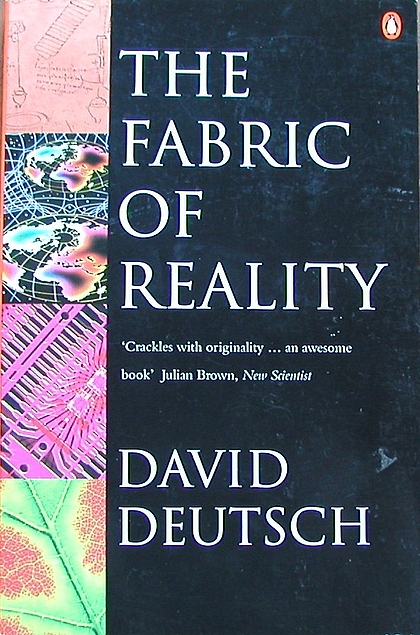
David Deutsch "The Fabric Of Reality" (Penguin)


David Deutsch's Fabric of Reality is woven from what he refers to as "four strands": the multiverse interpretation of quantum physics (credited to Hugh Everett), evolutionary biology grounded in genetic selection (Richard Dawkins), the postulate of a universal computer (Alan Turing), and scientific epistemology composed of problems and explanations (Karl Popper). Near the end of the book, physicist Deutsch admits that when first observing similarities and connections among these four, he had taken the latter three to be emergent from, if not reducible to, quantum physics. Ultimately, though, he presents them as equally fundamental and mutually illuminating. According to Deutsch, all four of these theories have arrived at the practical domination of their respective fields, vanquishing competing theories, but all four have failed to be integrated into a wider worldview. It's his contention that they need each other to fill the explanatory gaps that make them each seem "'naive,' 'narrow,' 'cold,' and so on" (346).

The book is divided into fourteen chapters, each of which ends with a glossary, a thumbnail summary of the chapter's argument, and a tease for the following chapter. This signposting structure would make it easy to cherry-pick chapters of interest to a particular reader. On the other hand, the thesis of the whole book relies on the interdependence of the concepts treated in different chapters. So--other than the philosophy of mathematics in Chapter 10, which the author himself says can be merely skimmed by those without the strong prior orientation to that field - it's probably worth reading from cover to cover for full appreciation. I enjoyed doing so, at any rate. Although the concepts may sometimes be on the forbidding side, the prose is lucid. I especially liked the philosophical dialogue in Chapter 7.

This text is now twenty years old, and most of its component ideas were at least that old when it was written. Deutsch insists that his thesis is a "conservative" approach to elaborating the worldview that is a consequence of "taking seriously" the four theoretical perspectives of the book. Considering that, by his estimation, the explanations that they afford are the best for their respective fields of inquiry, he says that the worldview that he has assembled from them is the one that needs to be challenged by new ideas in the future. Despite all of the advances in communications technology in the 21st century, though, this contemporary philosophical worldview has yet to be accessed even by many readers who will find it interesting and perhaps compelling.
jazzy_dave: (bookish)
David Deutsch "The Fabric Of Reality" (Penguin)


David Deutsch's Fabric of Reality is woven from what he refers to as "four strands": the multiverse interpretation of quantum physics (credited to Hugh Everett), evolutionary biology grounded in genetic selection (Richard Dawkins), the postulate of a universal computer (Alan Turing), and scientific epistemology composed of problems and explanations (Karl Popper). Near the end of the book, physicist Deutsch admits that when first observing similarities and connections among these four, he had taken the latter three to be emergent from, if not reducible to, quantum physics. Ultimately, though, he presents them as equally fundamental and mutually illuminating. According to Deutsch, all four of these theories have arrived at the practical domination of their respective fields, vanquishing competing theories, but all four have failed to be integrated into a wider worldview. It's his contention that they need each other to fill the explanatory gaps that make them each seem "' naive,' 'narrow,' 'cold,' and so on" (346).

The book is divided into fourteen chapters, each of which ends with a glossary, a thumbnail summary of the chapter's argument, and a tease for the following chapter. This signposting structure would make it easy to cherry-pick chapters of interest to a particular reader. On the other hand, the thesis of the whole book relies on the interdependence of the concepts treated in different chapters. So--other than the philosophy of mathematics in Chapter 10, which the author himself says can be merely skimmed by those without the strong prior orientation to that field - it's probably worth reading from cover to cover for full appreciation. I enjoyed doing so, at any rate. Although the concepts may sometimes be on the forbidding side, the prose is lucid. I especially liked the philosophical dialogue in Chapter 7.

This text is now twenty years old, and most of its component ideas were at least that old when it was written. Deutsch insists that his thesis is a "conservative" approach to elaborating the worldview that is a consequence of "taking seriously" the four theoretical perspectives of the book. Considering that, by his lights, the explanations that they afford are the best for their respective fields of inquiry, he says that the worldview that he has assembled from them is the one that needs to be challenged by new ideas in the future. Despite all of the advances in communications technology in the 21st century, though, this contemporary philosophical worldview has yet to be accessed even by many readers who will find it interesting and perhaps compelling.
jazzy_dave: (Default)
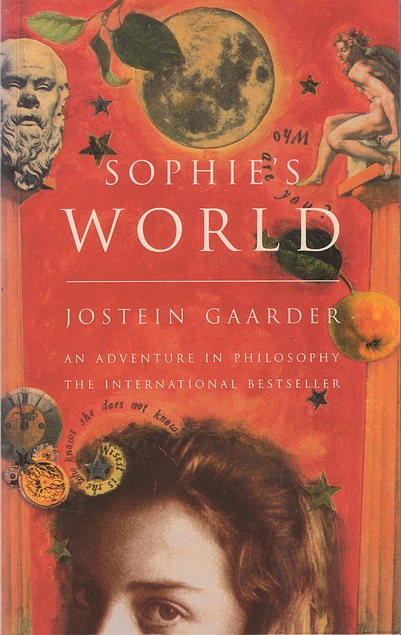
Jostein Gaarder "Sophie's World: A Novel About the History of Philosophy" (Orion)


This is such a readable book and the third time I have reread it. In fact, it turns out to be a wonderful journey into the history of philosophy.

A 14-year-old Norwegian schoolgirl, Sophie, comes home from school and finds in her mailbox, an unstamped letter addressed to her contains a note that just asks "Who are you?". A couple of minutes later, she finds another letter in her mailbox addressed to her, containing yet another note with a simple question "Where does the world come from?. And still yet later on in the day, she finds in her mailbox, a postcard addressed to someone named Hilde, but in care of her address.

And so the letters prick Sophie's curiosity and get her to start thinking about who's sending these letters to her, what they mean, and really.... where DOES the world come from?

A few days later, Sophie receives a package, and therein begins her introduction to philosophy. We are taken on a journey tracing the history of philosophy from the natural philosophers in Greece back in about 500B.C., to Socrates, Plato, and Aristotle, the moving through the ages and continents to St Thomas Aquinas, Descartes, Hume, Kant, Kierkegaard, Marx, Darwin, and Freud.

For anyone looking for an easy way to learn philosophy or interested in a refresher course in philosophy, this is a good book to pick up. Sophie's child-like wide-eyed curiosity and eagerness to explore new ways of thinking put a fresh new face on the subject.

And by the way, who's Hilde and why is someone sending postcards for her to Sophie? The answer to this puzzle is quite a surprise.
jazzy_dave: (bookish)
Jostein Gaarder "Sophie's World: A Novel About the History of Philosophy" (Orion)


This is such a readable book and the third time I have reread it. In fact, it turns out to be a wonderful journey into the history of philosophy.

A 14-year-old Norwegian schoolgirl, Sophie, comes home from school and finds in her mailbox, an unstamped letter addressed to her contains a note that just asks "Who are you?". A couple of minutes later, she finds another letter in her mailbox addressed to her, containing yet another note with a simple question "Where does the world come from?. And still yet later on in the day, she finds in her mailbox, a postcard addressed to someone named Hilde, but in care of her address.

And so the letters prick Sophie's curiosity and get her to start thinking about who's sending these letters to her, what they mean, and really.... where DOES the world come from?

A few days later, Sophie receives a package, and therein begins her introduction to philosophy. We are taken on a journey tracing the history of philosophy from the natural philosophers in Greece back in about 500B.C., to Socrates, Plato, and Aristotle, the moving through the ages and continents to St Thomas Aquinas, Descartes, Hume, Kant, Kierkegaard, Marx, Darwin, and Freud.

For anyone looking for an easy way to learn philosophy or interested in a refresher course in philosophy, this is a good book to pick up. Sophie's child-like wide-eyed curiosity and eagerness to explore new ways of thinking put a fresh new face on the subject.

And by the way, who's Hilde and why is someone sending postcards for her to Sophie? The answer to this puzzle is quite a surprise.


Profile

jazzy_dave: (Default)
jazzy_dave

January 2026

S M T W T F S
    1 23
4 5678910
11121314151617
18192021222324
25262728293031

Syndicate

RSS Atom

Most Popular Tags

Style Credit

Expand Cut Tags

No cut tags
Page generated Jan. 6th, 2026 03:05 pm
Powered by Dreamwidth Studios