Book 8 - Eli Pariser "The Filter Bubble"
Jan. 25th, 2016 03:44 pm![[personal profile]](https://www.dreamwidth.org/img/silk/identity/user.png) jazzy_dave
jazzy_daveEli Pariser "The Filter Bubble" (Penguin)
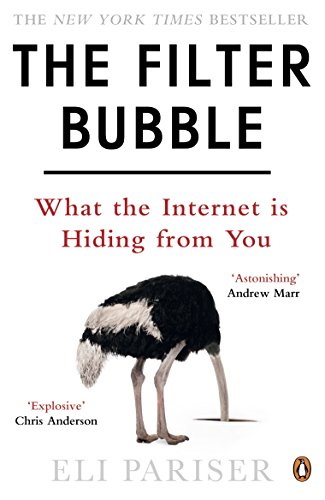
Another paperback from my covert charity shop visits from last year and which i started reading in December.
The central message in The Filter Bubble is that the search algorithms used by websites like Amazon, Netflix, Facebook, and (most perniciously, Pariser argues) Google are incredibly good at showing us content that similar to content we’ve already looked at. The cumulative effect of all this, Pariser argues, is that if we do nothing we wind up living in a tightly circumscribed online world filled with information, ideas, and outlooks already familiar to us: the “filter bubble” of the title. Pariser also has reservations about the ways in which companies like Google and Facebook gather, store, and use information about us: the raw material their algorithms use to decide what we want to see. The internet shows us what we want to see, not what we need to see, and that deeply frustrates him.
What frustrated me, for virtually the entire length of the book, is that Pariser seems far more concerned with warning readers that they’re on the road that leads to filter-bubble Hell than with asking why that particular route might have seemed – or might still seem – more attractive than the other routes available. He never stops, for example, to consider why filters feel like essential tools when exploring even a narrow, bounded world like Facebook (much less the web as a whole): A hyper-abundance of information, a horrific signal-to-noise ratio, and users with limited time and shaky information- literacy skills. Filtered search results and tailored news feeds have flourished, in part, because people find them useful and efficient.
Pariser, who wants them to return a higher proportion of results that aren’t just what the user would expect (and thus want) is thus in the odd position of arguing that search engines would be improved if they were – in the eyes of most users – made less efficient. Arguing that efficiency isn’t an absolute virtue is far from absurd (it works for hand-dipped milkshakes, artisan bread, and craft-brewed beer) but it’s hard to see it being used to sell lifeboat bilge pumps or body armor. Or search engines. Some things, you just want to be boringly efficient.
The premise underlying Pariser’s case for less-tightly-filtered, (and thus seemingly less-efficient) search engines and news feeds isn’t absurd, either. It’s that “efficiency” in search isn’t giving the user the information they want, it’s giving them the information they need – the information that will make them better informed, better able to think, and thus better able to deal with the world. It’s far from clear, however, that an internet search engine programmed (by others) to give them that is any more desirable than one programmed (by others) to give them just what they want. It’s also far from clear that most people, if presented with that broader range of information, would not – using their own homegrown filters – immediately weed out (as “irrelevant,” “biased,” “uninteresting” or simply “wrong”) precisely the information that Pariser is so determined to provide them with.
Another paperback from my covert charity shop visits from last year and which i started reading in December.
The central message in The Filter Bubble is that the search algorithms used by websites like Amazon, Netflix, Facebook, and (most perniciously, Pariser argues) Google are incredibly good at showing us content that similar to content we’ve already looked at. The cumulative effect of all this, Pariser argues, is that if we do nothing we wind up living in a tightly circumscribed online world filled with information, ideas, and outlooks already familiar to us: the “filter bubble” of the title. Pariser also has reservations about the ways in which companies like Google and Facebook gather, store, and use information about us: the raw material their algorithms use to decide what we want to see. The internet shows us what we want to see, not what we need to see, and that deeply frustrates him.
What frustrated me, for virtually the entire length of the book, is that Pariser seems far more concerned with warning readers that they’re on the road that leads to filter-bubble Hell than with asking why that particular route might have seemed – or might still seem – more attractive than the other routes available. He never stops, for example, to consider why filters feel like essential tools when exploring even a narrow, bounded world like Facebook (much less the web as a whole): A hyper-abundance of information, a horrific signal-to-noise ratio, and users with limited time and shaky information- literacy skills. Filtered search results and tailored news feeds have flourished, in part, because people find them useful and efficient.
Pariser, who wants them to return a higher proportion of results that aren’t just what the user would expect (and thus want) is thus in the odd position of arguing that search engines would be improved if they were – in the eyes of most users – made less efficient. Arguing that efficiency isn’t an absolute virtue is far from absurd (it works for hand-dipped milkshakes, artisan bread, and craft-brewed beer) but it’s hard to see it being used to sell lifeboat bilge pumps or body armor. Or search engines. Some things, you just want to be boringly efficient.
The premise underlying Pariser’s case for less-tightly-filtered, (and thus seemingly less-efficient) search engines and news feeds isn’t absurd, either. It’s that “efficiency” in search isn’t giving the user the information they want, it’s giving them the information they need – the information that will make them better informed, better able to think, and thus better able to deal with the world. It’s far from clear, however, that an internet search engine programmed (by others) to give them that is any more desirable than one programmed (by others) to give them just what they want. It’s also far from clear that most people, if presented with that broader range of information, would not – using their own homegrown filters – immediately weed out (as “irrelevant,” “biased,” “uninteresting” or simply “wrong”) precisely the information that Pariser is so determined to provide them with.

![[identity profile]](https://www.dreamwidth.org/img/silk/identity/openid.png)
![[community profile]](https://www.dreamwidth.org/img/silk/identity/community.png)
no subject
Date: 2016-01-25 05:17 pm (UTC)no subject
Date: 2016-01-25 05:28 pm (UTC)The other way to avoid being filtered is "don’t be a mouse". He says "Don’t go back to the same websites over and over again, but diversify your interests. Use more of Twitter, not Facebook to get information",
no subject
Date: 2016-01-26 10:09 am (UTC)no subject
Date: 2016-01-25 06:01 pm (UTC)Of course real life solves some of this, too. Knocking on a variety of literal doors helps.
And this is why I'm still a big fan of print journalism, despite its arguable conservation downsides. The cost keeps going up for our hard copy subscription, and we recently had a local distribution debacle as well. But the journalism quality is, as a whole, no doubt higher, and you just *absorb* it differently. As for the self-filter conundrum you mention at the end--I'm not sure how it plays out on screen, but when looking at two large expanses of newsprint spread out ahead of me, I certainly do notice and take in more than I do online, and I say that with confidence. I hope we can eventually find a compromise--there are some sections that will ultimately be fine online only and maybe there is a happy medium between door-to-door delivery and making to the corner store (which is easier said than done in even slightly less dense areas where the corner store is a jaunt, even if technically walkable) with end-of-street drop off points or something? You can tell I've thought about this quite a bit, haha.
no subject
Date: 2016-01-25 06:45 pm (UTC)which is why with most search engines, I mix it up with totally random topics... just to keep them on their algorithms..
no subject
Date: 2016-01-25 10:20 pm (UTC)no subject
Date: 2016-01-25 08:03 pm (UTC)But I suspect there's a flipside, that users share some responsibility by their impatience. I know for a fact (because it's closely related to my job) that traversing graphs of information can be very expensive, and that's probably where you would find interesting but not obvious links. If everyone expects to get search results in under a second, there's only so much of the graph that can be discovered. Who's volunteering to slow down their site, or to wait until tomorrow to be emailed the results of their query?
Also, did the book have anything to say about ads and ad blocking? That's an area where there's an arms race. Obviously advertisers want to "target" their spend with the greatest possible precision - which in turn could give users correspondingly narrow results.
no subject
Date: 2016-01-25 10:19 pm (UTC)no subject
Date: 2016-01-25 10:02 pm (UTC)no subject
Date: 2016-01-26 01:13 am (UTC)The only problem is, that's not always true. :( One day I might look up something or some product, and then for days I get "ads" for that type of thing, and I really couldn't care less about it any more.
The premise underlying Pariser’s case for less-tightly-filtered, (and thus seemingly less-efficient) search engines and news feeds isn’t absurd, either.
I don't really want a less efficient search engine, but I really wish all these other sites wouldn't ad me to death. When I am on facebook or gmail I don't want to see ads for things. Ugh...
I guess that means I lean towards his feelings, but not in his camp. :p
Hugs, Jon
no subject
Date: 2016-01-26 02:26 am (UTC)I've been playing with the idea of adding encryption to my computer, there are several ways of doing it and lots of encryption options can be working in conjunction with each other. I have even spoken with a colleague who has encryption on his computer and we discussed how using search engines was different on an encrypted computer. He said it was less 'refined' and more vague and instead of finding the needed link on the first page you would have to scan a few pages of suggested links. I honestly wouldn't mind that, it's almost like 'if you like this, you might be interested in that' but not from being spied on, but because you are NOT being spied on LOL
no subject
Date: 2016-01-26 04:05 am (UTC)