Librarians and Wormholes
Jan. 3rd, 2015 06:36 pm![[personal profile]](https://www.dreamwidth.org/img/silk/identity/user.png) jazzy_dave
jazzy_daveI have been watching episodes of The Librarians on the Syfy channel. I really do not know what to think of it and in some ways reminds me of Waehouse 13, although i did enjoy the Boston episode with the labyrinth and the Minotaur.
I also like the idea of a representative door to anywhere from the library to anywhere else, and hence an Einstein Rosen bridge , or in more familiar terms, a wormhole,that allows instantaneous travel between points.
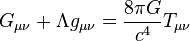
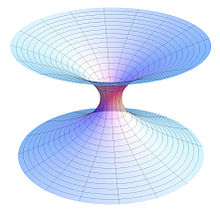
As yet researchers have no observational evidence for wormholes, but the equations of the theory of general relativity have valid solutions that contain wormholes. Because of its robust theoretical strength, a wormhole is one of the great physics metaphors for teaching general relativity (see formula below). The first type of wormhole solution discovered was the Schwarzschild wormhole, which would be present in the Schwarzschild metric describing an eternal black hole, but it was found that it would collapse too quickly for anything to cross from one end to the other. Wormholes that could be crossed in both directions, known as traversable wormholes, would only be possible if exotic matter with negative energy density could be used to stabilize them.
An affect called the Casimir effect shows that quantum field theory allows the energy density in certain regions of space to be negative relative to the ordinary vacuum energy, and it has been shown theoretically that quantum field theory allows states where energy can be arbitrarily negative at a given point.
It has been hypothesized that such effects might make it possible to stabilize a traversable wormhole. Physicists have not found any natural process that would be predicted to form a wormhole naturally in the context of general relativity, although the quantum foam hypothesis is sometimes used to suggest that tiny wormholes might appear and disappear spontaneously at the Planck scale, and stable versions of such wormholes have been suggested as dark matter candidates. It has also been proposed that, if a tiny wormhole held open by a negative-mass cosmic string had appeared around the time of the Big Bang, it could have been inflated to macroscopic size by cosmic inflation.
The American theoretical physicist John Archibald Wheeler coined the term wormhole in 1957; the German mathematician Hermann Weyl, however, had proposed the wormhole theory in 1921, in connection with mass analysis of electromagnetic field energy.
I digress, going back to this fantasy series,it is too wayward as yet for me to like it. In general , i find it silly, and despite the fact that Warehouse 13 had silly moments, it had darker tones. For the time being i shall sit on the fence before committing to the series one way or another.
I see that there is another Spielberg related series coming to the small screen called Extant, which with Halle Berry in it, looks promising.
I also like the idea of a representative door to anywhere from the library to anywhere else, and hence an Einstein Rosen bridge , or in more familiar terms, a wormhole,that allows instantaneous travel between points.
As yet researchers have no observational evidence for wormholes, but the equations of the theory of general relativity have valid solutions that contain wormholes. Because of its robust theoretical strength, a wormhole is one of the great physics metaphors for teaching general relativity (see formula below). The first type of wormhole solution discovered was the Schwarzschild wormhole, which would be present in the Schwarzschild metric describing an eternal black hole, but it was found that it would collapse too quickly for anything to cross from one end to the other. Wormholes that could be crossed in both directions, known as traversable wormholes, would only be possible if exotic matter with negative energy density could be used to stabilize them.
An affect called the Casimir effect shows that quantum field theory allows the energy density in certain regions of space to be negative relative to the ordinary vacuum energy, and it has been shown theoretically that quantum field theory allows states where energy can be arbitrarily negative at a given point.
It has been hypothesized that such effects might make it possible to stabilize a traversable wormhole. Physicists have not found any natural process that would be predicted to form a wormhole naturally in the context of general relativity, although the quantum foam hypothesis is sometimes used to suggest that tiny wormholes might appear and disappear spontaneously at the Planck scale, and stable versions of such wormholes have been suggested as dark matter candidates. It has also been proposed that, if a tiny wormhole held open by a negative-mass cosmic string had appeared around the time of the Big Bang, it could have been inflated to macroscopic size by cosmic inflation.
The American theoretical physicist John Archibald Wheeler coined the term wormhole in 1957; the German mathematician Hermann Weyl, however, had proposed the wormhole theory in 1921, in connection with mass analysis of electromagnetic field energy.
I digress, going back to this fantasy series,it is too wayward as yet for me to like it. In general , i find it silly, and despite the fact that Warehouse 13 had silly moments, it had darker tones. For the time being i shall sit on the fence before committing to the series one way or another.
I see that there is another Spielberg related series coming to the small screen called Extant, which with Halle Berry in it, looks promising.
![[identity profile]](https://www.dreamwidth.org/img/silk/identity/openid.png)
![[community profile]](https://www.dreamwidth.org/img/silk/identity/community.png)
no subject
Date: 2015-01-03 07:01 pm (UTC)But, it's actually awful. That's too bad, as it has so many things going for it. For example, Pierce Gagnon has got to be the creepiest child actor of all time.
I don't think the Librarians are going to move from its current sweet spot, in terms of tone. Shows like this tend to get goofier rather than darker. But, maybe they will surprise us there. But, regardless of the super cheese, my family likes watching it.
no subject
Date: 2015-01-03 11:50 pm (UTC)no subject
Date: 2015-01-04 12:16 am (UTC)no subject
Date: 2015-01-03 07:05 pm (UTC)no subject
Date: 2015-01-03 07:16 pm (UTC)no subject
Date: 2015-01-03 08:56 pm (UTC)no subject
Date: 2015-01-04 12:50 am (UTC)no subject
Date: 2015-01-03 10:33 pm (UTC)no subject
Date: 2015-01-03 11:38 pm (UTC)no subject
Date: 2015-01-03 11:47 pm (UTC)Imagine that you're blind and over time you've developed a technique for determining how far away an object is by throwing a medicine ball at it. If you throw your medicine ball at a nearby stool, the ball will return quickly, and you'll know that it's close. If you throw the ball at something across the street from you, it'll take longer to return, and you'll know that the object is far away.
The problem is that when you throw a ball -- especially a heavy one like a medicine ball -- at something like a stool, the ball will knock the stool across the room and may even have enough momentum to bounce back. You can say where the stool was, but not where it is now. What's more, you could calculate the velocity of the stool after you hit it with the ball, but you have no idea what its velocity was before you hit it.
This is the problem revealed by Heisenberg's Uncertainty Principle.
To know the velocity of a quark we must measure it, and to measure it, we are forced to affect it. The same goes for observing an object's position. Uncertainty about an object's position and velocity makes it difficult for a physicist to determine much about the object.
Of course, physicists aren't exactly throwing medicine balls at quanta to measure them, but even the slightest interference can cause the incredibly small particles to behave differently.
no subject
Date: 2015-01-03 11:55 pm (UTC)!!
Date: 2015-01-04 12:28 am (UTC)