Book 99 - David Byrne "How Music Works"
Dec. 28th, 2018 12:51 pm![[personal profile]](https://www.dreamwidth.org/img/silk/identity/user.png) jazzy_dave
jazzy_daveDavid Byrne "How Music Works" (Canongate Books)
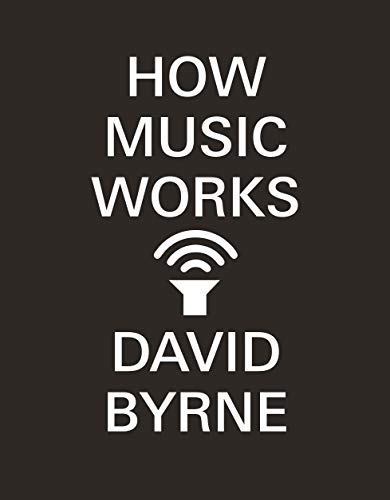
Byrne, like Devo frontman Mark Mothersbaugh, has remained very active in music, even though the days of large stadium shows have long passed him by. If your tastes venture beyond Top-40 or American Idol, then when David Bryne talks, it's worth taking the time to listen.
How Music Works is a chimaera of a book. In parts, Bryne does explain the evolution of music from primitive man, and how it functions on a subconscious level. This ground has already been recently covered by Alex Ross in his excellent book "The Rest is Noise," which is duly credited by Bryne. But of greatest interest to me was how the industry works -- and how it evolved from a label-centric distribution model to today's internet free-for-all. Bryne tells us about the finance of the business -- how in the day of the label, bands might be courted with private planes and mountains of cocaine, but all of that expense was applied against advances given to artists, and in many cases, blockbuster albums could net little or no profit. The real money is in song credits that could provide perpetual income. In this, Byrne has done quite well for himself, well enough to eke out a career in music with the resources to conduct his own financial experiments in music distribution. He has discovered the label no longer plays a pivotal role for artists seeking a profit. A label can create greater exposure but at greater cost. When the artist can keep a majority of profits from the get-go, as long as he has some following, a decent wage can be earned. Byrne explains that today, the means to create a top-notch recording are within the means of anyone so inclined with a PC and skills. This also cuts down or eliminates recording studio expense (many famous studios have been shuttering their doors of late).
And of course, we get anecdotes from Byrne's colourful career. We learn about the inner-workings of that magical New York nightclub, CBGB, and how the likes of The Ramones, Blondie, Patty Smith, and The Talking Heads all rose from neighbourhood rats to international prominence, ostensibly on the wave of punk rock, although in the case of The Talking Heads, they never really fit the canonical punk motif.
Since the book is a collection of essays, sometimes the same subjects (and indeed the same references) come up several times, making the book occasionally repetitive. Unless you're a working musician, the book provides details about how music is currently made and consumed that you've probably never thought about before. That's a great thing for a book to do.
Byrne, like Devo frontman Mark Mothersbaugh, has remained very active in music, even though the days of large stadium shows have long passed him by. If your tastes venture beyond Top-40 or American Idol, then when David Bryne talks, it's worth taking the time to listen.
How Music Works is a chimaera of a book. In parts, Bryne does explain the evolution of music from primitive man, and how it functions on a subconscious level. This ground has already been recently covered by Alex Ross in his excellent book "The Rest is Noise," which is duly credited by Bryne. But of greatest interest to me was how the industry works -- and how it evolved from a label-centric distribution model to today's internet free-for-all. Bryne tells us about the finance of the business -- how in the day of the label, bands might be courted with private planes and mountains of cocaine, but all of that expense was applied against advances given to artists, and in many cases, blockbuster albums could net little or no profit. The real money is in song credits that could provide perpetual income. In this, Byrne has done quite well for himself, well enough to eke out a career in music with the resources to conduct his own financial experiments in music distribution. He has discovered the label no longer plays a pivotal role for artists seeking a profit. A label can create greater exposure but at greater cost. When the artist can keep a majority of profits from the get-go, as long as he has some following, a decent wage can be earned. Byrne explains that today, the means to create a top-notch recording are within the means of anyone so inclined with a PC and skills. This also cuts down or eliminates recording studio expense (many famous studios have been shuttering their doors of late).
And of course, we get anecdotes from Byrne's colourful career. We learn about the inner-workings of that magical New York nightclub, CBGB, and how the likes of The Ramones, Blondie, Patty Smith, and The Talking Heads all rose from neighbourhood rats to international prominence, ostensibly on the wave of punk rock, although in the case of The Talking Heads, they never really fit the canonical punk motif.
Since the book is a collection of essays, sometimes the same subjects (and indeed the same references) come up several times, making the book occasionally repetitive. Unless you're a working musician, the book provides details about how music is currently made and consumed that you've probably never thought about before. That's a great thing for a book to do.

![[community profile]](https://www.dreamwidth.org/img/silk/identity/community.png)
no subject
Date: 2018-12-28 07:38 pm (UTC)I would've loved for Talking Heads to have gone on recording, but all good things must come to an end.
no subject
Date: 2018-12-28 08:50 pm (UTC)no subject
Date: 2018-12-28 09:24 pm (UTC)I happily found a really inexpensive HB on Amazon used, dunno what the market is like on amazon.co.uk.
no subject
Date: 2018-12-28 09:28 pm (UTC)