jazzy_dave: (books n tea)
Grayson Perry "Playing to the Gallery" (Penguin Books)


A genuine attempt at an accessible work on understanding contemporary art for the average person, by one of Britain's more accessible and popular contemporary artists. I like Grayson Perry and his work, and I have a lot of time for anything he wants to say on this (and several other) subjects. I find myself nodding along to a lot of what he writes here, and he does raise some thought provoking points.

However, somehow it doesn't add up to more than the sum of its parts. There is no great overarching vision here, just a series of interesting points well made, so it ends up lacking a little coherence overall. Also, he is still very much an insider to the art world, so sometimes what he says seems to lack a little insight into what those who are truly on the outside might feel (lots of talk about making money out of the art world, and thinking about what curators value in a work etc; quite minority interests, even for other artists that don't exist in that rarefied strata) But, worth a look, not least for his humorous sketches that litter the book, and manage to capture some aspects of contemporary culture pretty neatly.
jazzy_dave: (books n tea)
Gayford Martin "Spring Cannot be Cancelled: David Hockney in Normandy" (Thames & Hudson)


The book is somewhat falsely advertised though: “It is based on a wealth of new conversations and correspondence between Hockney and art critic Martin Gayford, his long-time friend and collaborator. Their exchanges are illustrated by a selection of Hockney’s new, unpublished Normandy iPad drawings and paintings alongside works by van Gogh, Monet, Bruegel, and others.”

This gives the impression that the book consists mainly of “their exchanges”, but that’s not true at all. The book is mainly Martin Gayford’s musings and anecdotes about Hockney and art in general, indeed based on their Facetime talks and emails. I’d say the bulk of the text, about 80%, is Gayford’s prose, intersected with fragments of what Hockney said or wrote.

Not that it is fully without problems: the main issue being that Gayford isn’t critical at all, and I think the book would have benefited if he would have given a different viewpoint to some of Hockney’s statements – most notably about Duchamp and about photography.

Another issue is its overall lightness: some parts border on the clichéd – panta rhei, true, but that isn’t very insightful. Gayford is at his best when he simply tries to describe Hockney’s work: “a seamless blend of the sophisticated and the straightforward.”
jazzy_dave: (bookish)
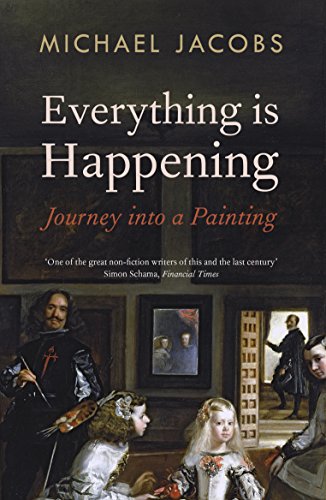
Michael Jacobs "Everything is Happening: Journey into a Painting" (Granta Books)


The story of a friendship is the frame for a dying man's life-lusting memoir, nested into his last travelling adventure in search of meaning inside a painting.

The narration of a life-long obsession becomes a mystery investigation, truncated by death and touchingly completed by the author's best friend, and at the same time reaches the worlds of politics and philosophy, through the recalling of the Civil War in Spain, through loving memories of Anthony Blunt as a great teacher and as a scapegoat of philistine nationalism, and through an attempt at defining the nature of art as life, far from the "sunless" arid interpretations of the academic currents Jacobs encountered during his studies as art historian. By the way, his brief treatment of the way his peers have misunderstood Foucault is a pearl of concision and hilarious in its own way.
A book bursting with love - for art, for friends, for freedom of thought and interpretation, for Spain, Italy and South America, for people. I guess it will stay with me more than I thought it would.

EDIT: I left out the book's many shortcomings, such as the self-consciously embarrassed elitism of the Oxbridge alumni condemning the mass tourism that is nothing else than a side effect of accessibility of art, well, you know, to the masses; or the incredible provincialism of the British intellectual élites in the way they still live the Mediterranean as exotic dreamland without ever really engaging with it. There is a description of the crisis, the corruption scandals in Spain and of the Indignados protests that may look as politically conscious, but betrays a substantial hauteur, with Jacobs shaking his head at the plight of the protesting masses before proceeding to a luxurious cocktail on a rooftop bar with a curator quite on the aristocratic side of Spanish society. Vulliamy's remark, in the coda, that his liberally Marxist friend brought the rage of the protesting masses with him inside the museum for a while, well, that would be comical if it were not infuriating.

However grating, though, these shortcomings don't subtract from the general tone of honesty of the book; instead, seem to contribute to it. Imperfect as everybody else, these two men are not afraid to expose themselves for whom they truly are in the interest of a better understanding of art and of its meaning and appreciated that more than I would have a rigorously correct analysis devoid of interior truth.

jazzy_dave: (bookish)
Herbert Read "The Meaning Of Art" (Faber & Faber)


First published in 1931, revised in 1949 and reprinted by Penguin as a "Pelican" blue paperback reference for many years. Our copy has 64 black and white photographic plates. Sir Herbert Read was a distinguished English professor of Fine Arts in many university posts, a former curator at the Victoria and Albert Museum, and a published poet as well. In this book, he wrote a useful guide to the understanding and "appreciation of pictures and sculpture by defining the elements which go to their making". He presents "fundamental terms such as 'beauty', 'harmony' and 'pattern'" so viewers and critics of art may "use them with precision in their judgements".

"A large part of the book is devoted to a compact survey of the world's art, from primitive cave drawings to Jackson Pollock; an exposition designed to show the persistence of certain principles and aspirations throughout the history of art." Read summarizes "the essence of such movements as Gothic, Baroque, Impressionism, Expressionism, Surrealism and Tachism." - from the Penguin jacket notes

While a little dated, this book is a classic for university students of art and art history, and it's a good starting point for non-artists who wish to learn about this field from an expert.
Many other art history books are more lavishly illustrated and readable, but this is still an excellent academic introduction.
jazzy_dave: (bookish)
Ernst von Alphen "Francis Bacon and the Loss of Self" (Harvard University Press)


This book is a thought-provoking exploration of the renowned artist’s work. Van Alphen delves into the depths of Bacon’s paintings, unraveling their intricate layers and revealing profound insights.

Existential Anguish:
While many analyses of Bacon’s art focus on existential expression, Van Alphen takes a different approach. He contends that discussing Bacon’s work solely as an expression of an isolated individual overlooks an essential aspect—the viewer’s experience of pain.
Viewer’s Perspective: Van Alphen argues that the impact of Bacon’s art lies in how each viewer constructs their own identity from sensory evidence. We carve our “self” using the tools of representation, and Bacon’s unconventional manipulation of these conventions challenges our perception of reality.

Masculinity and Schizophrenia:
The book engages with theories of masculinity and schizophrenia, examining how Bacon’s distorted figures and fragmented narratives evoke a sense of dislocation and inner turmoil.


Pain and Identity:
Van Alphen’s investigation leads him to recognize that Bacon’s art resonates because it mirrors our individual struggle to define ourselves amid chaos. The pain we perceive in Bacon’s paintings reflects our own existential quest.
Beyond Surface Distortions: Rather than focusing solely on the superficial distortion of Bacon’s images, Van Alphen emphasizes the artist’s radical subversion of sensory conventions. It is this warping of conventions that confronts both “art” and our sense of self.

Conclusion
“Francis Bacon and the Loss of Self” invites readers to explore the interplay between art, identity, and perception. Van Alphen’s unique perspective enriches our understanding of Bacon’s enigmatic works, leaving us with a deeper appreciation for the complexities of selfhood and artistic expression.

Highly recommended to art students and imterested parties.
jazzy_dave: (books n tea)
Frank Zöllner "Leonardo" (Taschen)


Although the high-end books of Taschen have always been extremely good, I believe they have outdone themselves this time. It is a wonderful compilation of all the paintings, sketches, and drawing of Leonardo, including amazing close-ups of some of the paintings that let you really appreciate his technique and mastery. The images have excellent quality and the additional information given is also useful to put the images into historical context. I don't think I need to go into how incredible Leonardo was as a painter, engineer, etc., but you will definitely be amazed by the contents of this book.

Definitely a keeper for your home library.
jazzy_dave: (books n tea)
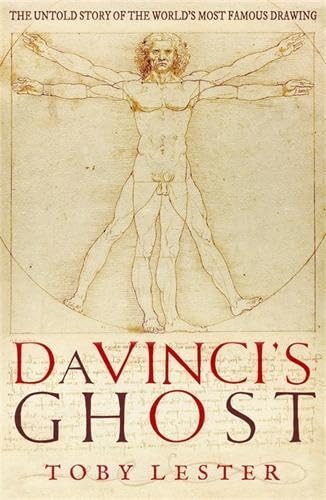
Toby Lester "Da Vinci's Ghost: The untold story of Vitruvian Man" )(Profile Books)


The drawing is well known, if not universally recognized (and I mean universal in the literal sense). Leonardo DaVinci’s print of the human male figure, arms and legs outstretched, touching both a square and a circle drawn within the square, can be found on t-shirts and mousepads, corporate logos, as well as parodies including The Simpsons. It’s on the €1 Euro coin, but perhaps most impressively, it’s been launced into space on several long distance and very long term missions.

It’s called “Vitruvian Man”, and among Leonardo’s eclectically vast tableau of work it remains one of his most enigmatic pieces. Author Toby Lester delves deeply into this single DaVinci masterpiece to expose its roots, its meanings and its lasting impressions.

Lester provides insight into the genesis of this work which currently resides at the Accademia Gallery in Venice, though it’s not currently on display. The name comes from the ancient Roman architect Vitruvius: “Writing at the dawn of the Roman imperial age, Virtuvius proposed that a man can be made to fit inside a circle and a square, and some fifteen hundred years later Leonardo gave that idea memorable visual form. But there’s much more to the story than that. Vitruvius had described his figure in an architectural context, insisting that the proportions of sacred temples should conform to the proportions of the idea human body – the design of which, he believed, conformed to the hidden geometry of the universe.”

Lester identifies some seriously heavy metaphysical connotations of the drawing as well, and the concept that it engenders. “The circle represented the cosmic and the divine; the square represented the earthly and the secular. Anybody proposing that a man could be made to fit inside both shapes was therefore making an age-old metaphysical statement. It was the world, in miniature.”

He continues, “It’s an idealized self-portrait in which Leonardo, stripped down to his essence, takes his own measure, and in doing so embodies a timeless human hope: that we must might have the power of mind to figure out how we fit into the grand scheme of things.”

Leonardo’s Virtuvian Man is estimated to be drawn in about 1490, but it’s just a guess since he didn’t date the work. The timing fits in with the style of draftsmanship, kinds of paper and pen he used, and even his handwriting of the time. Most importantly, it would place the work during “the very period in his career when he was immersed in his intensive study of human proportions and had a special interest in comparing his own measurements to those listed in Virtruvius’ work," wrote Lester.

Leonardo spent many years examining the human body in great detail, and he left numerous drawings based on his first-hand anatomical dissections. He started to make specific connections between the human body and architecture, which one can see creep into his notebook doodlings in the 1480s.

Vitruvius provided specific measurements of the idealized male form and these measurements act as a starting point for Leonardo’s work. Leonardo expands and improves upon the original description. Lester writes that DaVinci “corrected previous interpretations of an ancient text…to capture the essential message of (Vitruvius): that the human form embodied the natural harmonies present in the circle and the square.”

And the face upon the Vitruvian man is likely Leonardo’s self-portrait as well.

Lester’s book is a good read. It’s most successful, in my opinion, in its details surrounding Leonardo the man, his motivations, and the outline of his career. It fails, however, in its dubious connections presumed by author Lester, based upon an unfortunately incomplete record and circumstantial evidence. Leonardo spent some time with individuals that had their own connections with Vitruvius' work, and he had access to many historical works with various ties to the ancient work as well. Lester sometimes acknowledges that it’s “impossible to say”, for example, how much of certain concepts Leonardo was able to absorb by reading, but too often relies on ideas that Leonardo 'must have' read this, or 'likely' spoke to someone about that.

I enjoyed this book. Lester does a nice job writing readable history. The concepts are, at times, tough to wrap ones arms around, and Lester does well in providing just enough background and context to make things attainable.
jazzy_dave: (bookish)
Bansky "Wall and Piece" (Century Oublshing)


Banksy...the thinking person's favourite graffiti artist. He really is clever....and he can paint. I love his advice to stencil graffiti artists that the easiest way to become invisible is to wear a day-glo vest and carry a tiny transistor radio. Must say that I enjoyed this book.....it's pretty much all pictures except for a few explanatory notes here and there.

I don't know how Banksy interfaced with his publishers. He must have been identified by now but manages to still appear to be anonymous. The book appears to be a reasonable anthology of his work to date...though a high point for me was when one of his framed works was auctioned off for a huge price and immediately a hidden paper shredder was started up and the thing was half shredded. (Apparently it was meant to be totally shredded but something went wrong)....but the value of the piece was apparently increased by the incident. Love his rats pouring paint down the kerb....and his grenadier guards writing graffiti, and the naked guy hanging by one hand from a window whilst the "wronged" husband looks out the window for him. Happy to give this five stars.
jazzy_dave: (books n tea)
Martin Gayford "The Yellow House" (Penguin)


Vincent van Gogh and Paul Gauguin lived together for a few months in Arles, where they each produced some of their most famous paintings. But all was not peaceful and artistic harmony, and a lot of the problems stemmed from Vincent's volatility. This was an interesting and unflinching look at their lives during this time, including the bickering and brothels, and madness. Both of them wrote Vincent's brother (an art dealer) and others often, so there's quite a bit of documentation of how the two felt during those weeks. What really stuck with me were the descriptions of Vincent's mood swings. It's quite likely that one of the things plaguing him was bipolar disorder. This is a subject close to my heart, and I found it far more thought-provoking and even upsetting than I'd expected. But in a good way, if that makes any sense.

In terms of art, my favourites by far were the times when Gauguin and Vincent painted the same scene/person. Seeing their different interpretations side by side was simply fascinating. I definitely will need to pick up more books about these artists and their contemporaries.

A note on this edition: This is the fault of the publisher rather than the author, but the photographs really should be in colour. Colour is so important in both Vincent and Gauguin's paintings. I ended up looking up a lot of them on the net while I was reading. The black-and-white photos simply did not do them justice.
jazzy_dave: (beckett thoughts)
Philip Hook "Breakfast At Sotheby's" (Penguin)


Philip Hook's Breakfast at Sotheby's is a quick and enjoyable read. 'Perhaps most of us are train-spotters at heart' (page 182) wasn't a sentence I would expect to read within it. But there it is in the section explaining why some art collectors buy railway paintings. Hook even suggests that railways changed the way people painted, for instance, a quick day return may have encouraged a speedy Impressionist approach.

Anyway, this is an interesting and entertaining visage into the business of art from a real insider. Aside from being an excellent writer, Hook is pretty funny and self-deprecating, in true Brit fashion. My only issue with both of Hook’s books is the lack of quality color plates. Of course, the reason is the cost of these plates, but it took me longer to read because I had to keep referring to my laptop! Nonetheless, if the topic is interesting to you - I highly recommended it.
jazzy_dave: (bookish)
Nathaniel Harris "The Life And Works Of Gustav Klimt" (Parragon)


This is the second book I have on Klimt - the other is by Taschen.
Obviously, this tiny book can't compete with the larger publications like Taschen, nor does the author have much space to really discuss Klimt's work, but it was nonetheless a well-done book. The author has chosen a broad selection of Klimt's work, drawing from the mosaics, portraits, and landscapes throughout his well-established career to give readers a plausible overview of an artist without attempting (foolishly) to be comprehensive. Each selection is accompanied by a short paragraph that introduces each painting's main theme, while they are too brief to be truly satisfactory, we are given enough titillating details about Klimt's themes, motivations, and inspirations (as well as the artistic climate of the period) that we are drawn to seek out further information and discussion. My only complaint is that a few of the paintings seemed cropped in their reproduction, but I understand why the size restraints had to come into play.
jazzy_dave: (bookish)
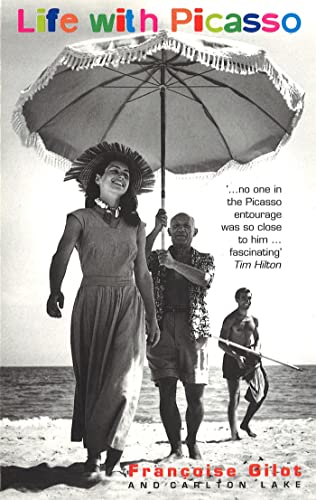
Francoise Gilot "Life With Picaso" (Virago)


An interesting book, but I kept wondering how Ms Gilot remembered all of what she wrote about. Did she take notes, knowing one day that she would write a book about her life with Picasso? If all of this is true, I also wonder why she put up with his behavior? But then, again, women today put up with a lot when in love with a narcissistic individual, don't they? Fascinating reading for anyone interested in knowing how other people are and especially one so well known for his artistic contributions to the world.

Despite his being an arrogant, sexist little ass, she treats him quite fairly and her observations and explanations about his art processes are really quite good. She also has some hilarious stories involving his eccentricities and general home life that are a lot of fun. It was a different time, in so many ways.

I recommend this book, even with all of my wonderings.
Ms. Gilot was an artist in her own right. She co-authored this book with Mr Carlton Luke, who speaks of having access to Picasso's letters to Ms. Gilot, and also of her notes and journals of the ten year period that she lived with Picasso.

I recommend this book to anyone interested in art, and especially Picasso's unique style. References throughout the book mention art that will be known by Picasso's fans; reading this book will shine much light on how an artist thinks as he is producing his masterpieces.

Even though this book is originally published in the 1960's, and that this is a 1990 paerback reissue, it is still a great book to help to understand the life of an painter.
jazzy_dave: (books n tea)
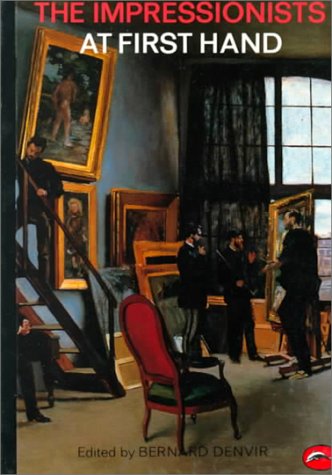
Bernard Denvir "The Impressionists at First Hand" (Thames & Hudson)


For those who think the Impressionists were simply painters of idyllic scenes (that would later launch a thousand coffee table books and calendars), this book clearly illustrates just how groundbreaking, controversial and challenging these artists really were. Reviled by the critics, misunderstood by the general public, and kept out of the mainstream salons, the Impressionists invented a whole new visual language, the ramifications of which would lead to endless breakthroughs in the modern art era.
jazzy_dave: (bookish)
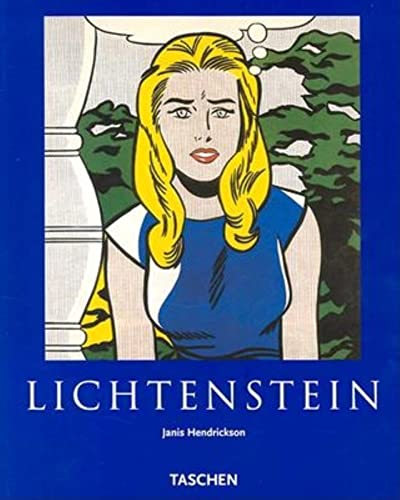
Janis Hendrickson "Lichtenstein" (Taschen)


This is a short and sweet book on Roy Lichtenstein. It isn't a very in-depth read but it will make you interested in learning more about the pop artist. It is an interesting, accessible introduction to Lichtenstein and his work. It doesn't suffer from translation problems as some other Taschen books I've read have, nor does it suffer from the awful metaphysical nonsense that the entry in this series about Turner does. I was a little disappointed to find that Lichtenstein's sculptural work is not given more than a couple of paragraphs, since they were a revelation in the exhibition I saw at the Tate years ago.

For the price, you can find it at and the time it takes to read it, it's a great book. But it does lack the full range of awesomeness that was Roy Lichtenstein.

Wall Art

Jan. 21st, 2022 09:09 am
jazzy_dave: (Default)
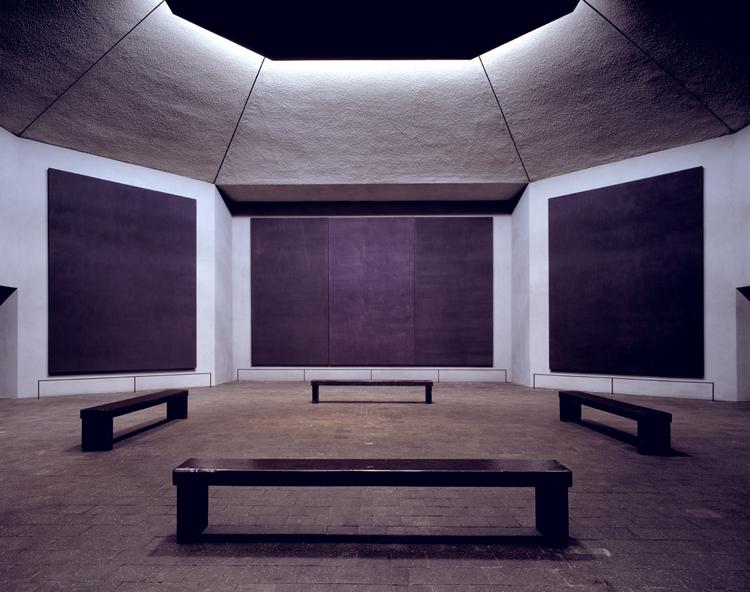
That empty wall I had when I took down the Xmas cards is now full again. I have attached my art to that wall, and as you can see have painted another in faux Rothko style. This one gently shades from blues to the darkest black. It’s now my coolest wall.

jazzy_dave: (Default)
No more signs of Xmas. All the cards are down, and the wall looks bare and sad. I might have to put up a few of my paintings of mine there or some posters.

I watched a programme today on the surrealist and self-promoter Salvador Dali. It was quite fascinating to see critics and art historians analyze his art in previous art documentaries.

Monday is quiz day for me. Counterpoint, the music quiz is back airing on BBC Radio 4 and this evening on the telly we had University Challenge, Only Connect and Mastermind.

I am selling my Ralph McTell LP – his début one on Transatlantic – so if anybody is interested in buying it, it is six pounds plus postage.

Back to the art documentaries now.
jazzy_dave: (bookish)
Agnès Poirier "Left Bank: Art, Passion and the Rebirth of Paris 1940–1950" (Bloomsbury)


I have seldom enjoyed a book as heartily as I have done with this account of the extraordinary explosion of intellectual and artistic creativity that occurred, despite circumstances that could scarcely have been less convivial, during the 1940s around the Left Bank in Paris.

Put most simply, this is a marvelous book: informative, enlightening, well researched, and also highly entertaining. (Less importantly, perhaps, but certainly worthy of mention, it also has the most delightful cover, featuring lovely line drawings of several of the leading characters in the intellectual and literary café-based society that thrived around Paris’s fabled left bank throughout the 1940s, both during and after the German occupation.)

Around this time last year, I took a punt on buying Sarah Bakewell’s At the Existentialist Café: Freedom, Being and Apricot Cocktails. That was a serendipitous purchase that pitched me into the lives of the Existentialists, a field in which I had been interested in ages. It was the unbridled joy that I derived from that chance purchase that prompted me to buy Agnès Poirier’s book, which proved to be equally felicitous.

I was intrigued by the dates cited in the subtitle. Knowing that Paris had been occupied by the Germans for the few years of that decade I had assumed that there had been very little intellectual, cultural, or political activity or progress. Nothing could be further from the truth. Certainly, the intellectual class was depleted, with members either having fled to Britain or America or signed up to fight the Germans. Jean-Paul Sartre, for example, had been drafted into the French army in 1939 and had served as a meteorologist before being taken as a prisoner. He escaped and returned to Paris where he resumed his former role teaching at the Lycée Pasteur. Back in Paris, and reunited with his life partner Simone de Beauvoir, he found a large circle of his former associates still living and writing, with the help of some judiciously turned blind eyes from various benign individuals within the Nazi administration. Their activity flourished around the cafes of the Left bank of the River Seine. Food and money were in short supply, but somehow, they always managed to find the means to visit a café, where in addition to holding lengthy tobacco- and alcohol-fuelled debates, most of their writing was undertaken. That is not to say that their synthesis and expression of ideas were always safe. Many of their circle were arrested, or simply vanished, but it still proved a period of immense fruitfulness.

That literary, philosophical and political fertility exploded after the Liberation, augmented by returning French writers and thinkers such as Albert Camus, and the influx of foreign artists and writers, and in particular a host of Americans such as Irwin Shaw, Saul Bellow, Richard Wright, and James Baldwin. Alongside them were Arthur Koestler and Samuel Beckett who had been based in Paris throughout.

Such a concentration of intellectual and artistic talent could not fail to yield durable riches. Not only did this group spawn existentialism as a philosophical concept, but it would facilitate the development of a brand of socialism wholly opposed to communism, and, in Simone de Beauvoir’s The Second Sex, yield one of the first and most enduring feminist manifestos.

The proximity of oppression and relentless distillation of ideas proved a heady aphrodisiac, and one of the most telling aspects of the book was the interlaced relationships between the leading protagonists. Simone de Beauvoir and Jean-Paul Sartre enjoyed a long-term off-and-on relationship, though that in no way inhibited them from taking on other lovers in-between times. Similarly, Arthur Koestler seemed intent on sleeping with as many of his female associates as possible, while still wishing to retain almost proprietorial rights over Mamaine Paget, his long-time partner and eventually (if only briefly) his wife. Meanwhile, Saul Bellow was openly dismissive, almost disgusted, by the constant round of infidelity among his French writing colleagues, although that did not prevent him from embarking on his own affairs while his wife and son were kept out of the way. As Agnes Poirier points out, life on the Left bank came to resemble Arthur Schnitzler’s play La Ronde.

All this might lead one to expect a sombre and dense tome, but Ms. Poirier deploys an elegant and engaging lightness of touch and scatters the book with lovely pen portraits of these cultural giants.

Highly recommended!
jazzy_dave: (Default)
 

Edvard Munch - The Scream

Munch's The Scream is an icon of modern art, the Mona Lisa for our time. As Leonardo da Vinci evoked a Renaissance ideal of serenity and self-control, Munch defined how we see our own age - wracked with anxiety and uncertainty.


See the source image

Francis Bacon - Screaming Pope

Bacon's popes depart even further from their source, often replacing the pontiff’s head with the equally recognizable screaming face of the wounded nurse mown down by the soldiers’ gunfire in the Odessa Steps sequence of Eisenstein's film Battleship Potemkin.


My own postmodern version - Blank Generation

Disturbing aren't they. Here s music to equal it -

Mark-Anthony Turnage - Three screaming popes (1988-1989)


Mark-Anthony Turnage (*1960) : Three screaming popes after Francis Bacon (1988-1989) - Birmingham Symphonic Orchestra - Simon Rattle, conductor
Francis Bacon (1909-1992) : Pope I (1951) - Aberdeen Art Gallery and Museums Collection, Aberdeen (UK) - Pope II (1951) - Kunsthalle Mannheim, Mannheim (Germany) - Pope III (1951)


ENJOY

Profile

jazzy_dave: (Default)
jazzy_dave

January 2026

S M T W T F S
    1 23
4 5678910
11121314151617
18192021222324
25262728293031

Syndicate

RSS Atom

Most Popular Tags

Style Credit

Expand Cut Tags

No cut tags
Page generated Jan. 6th, 2026 01:25 am
Powered by Dreamwidth Studios